
The global lithium battery industry in 2026 is undergoing rapid technological transformation, driven by breakthroughs in solid-state batteries, lithium-metal systems, sodium-ion alternatives, and advanced materials engineering. From leading universities to global battery giants, innovation is accelerating toward higher energy density, improved safety, faster charging, and lower cost—reshaping the future of electric vehicles (EVs), energy storage systems (ESS), and industrial electrification.
This report consolidates the latest global research progress and industry developments, following SEO best practices and structured for high discoverability in Google and AI-driven search engines.
1. Solid-State Batteries: The “Next-Generation Core Technology”
Solid-state battery technology remains the most anticipated breakthrough in the lithium battery ecosystem. It replaces flammable liquid electrolytes with solid materials, significantly improving safety, lifespan, and energy density.
Key Global Developments (2025–2026)
Researchers at Nankai University successfully tested a solid-state battery capable of over 1,000 km EV range, with energy density reaching 400 Wh/kg, far exceeding current commercial lithium-ion batteries (Nankai University)
Industry targets are pushing toward 600 Wh/kg, which could fundamentally redefine EV performance benchmarks (Nankai University)
A Finnish startup, Donut Lab, claims ultra-fast charging (5 minutes) and extremely long cycle life, though commercial validation remains under scrutiny (The Verge)
Industry Insight
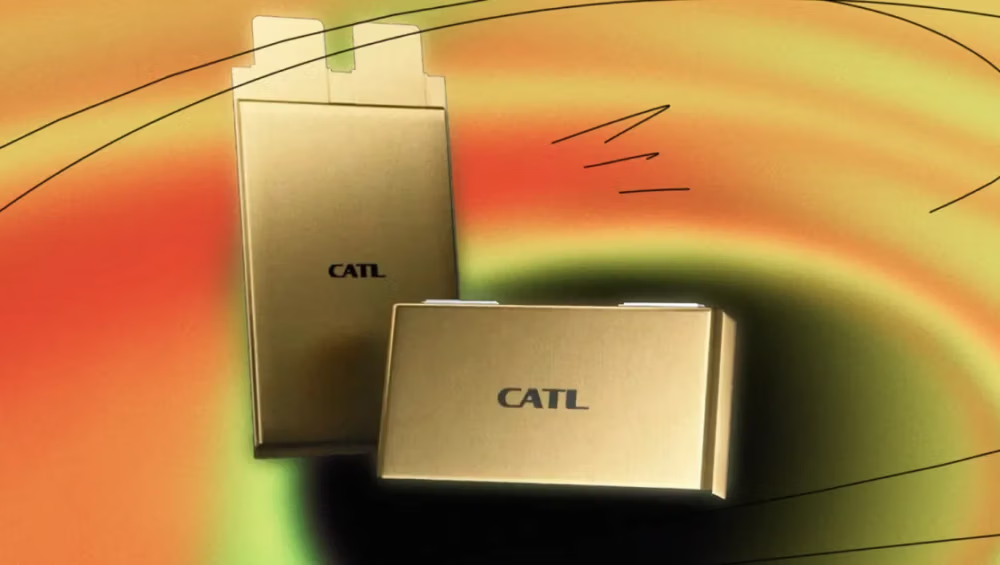
Solid-state batteries are widely considered the “holy grail” of battery technology, with major players such as CATL, Toyota, and Mercedes accelerating commercialization timelines toward the late 2020s (The Verge)
2. Lithium-Metal & Anode-Free Batteries: Breaking Energy Density Limits
Lithium-metal batteries represent a major leap beyond conventional graphite-based lithium-ion systems, offering significantly higher energy density.
Breakthrough Highlights
Scientists at Columbia University developed a gel electrolyte that stabilizes anode-free lithium batteries, solving dendrite formation issues—a major barrier to commercialization (TechRadar)
This approach enables:
Higher energy density (more active material per volume)
Improved safety (reduced thermal runaway risk)
Lower production costs
Technical Context
Lithium-metal batteries have long been limited by dendrite growth, which can cause short circuits. New electrolyte engineering strategies are now addressing this issue, marking a critical step toward commercialization (Wikipedia)
3. Sodium-Ion Batteries: A Strategic Alternative to Lithium
While not strictly lithium-based, sodium-ion batteries are rapidly emerging as a cost-effective and scalable complement to lithium technologies.
Global Progress
Energy density now reaches 160–200 Wh/kg, approaching LFP battery performance (iNetic Traction)
Tokyo University of Science achieved breakthroughs in fast-charging sodium-ion systems, reducing ion transport bottlenecks (Live Science)
Commercial metrics in 2026:
~175 Wh/kg energy density
Up to 10,000 cycle life
~60% lower cost than LFP batteries (LinkedIn)
Strategic Significance
Abundant raw materials (no lithium, cobalt, nickel dependency)
Superior thermal stability and safety (Energy Storage)
Strong adoption in grid-scale energy storage and low-cost EV segments
4. Silicon Anodes & Advanced Materials: Incremental but Crucial Innovation
Material science remains a key driver of performance improvements in lithium batteries.
Notable Advances
Silicon anode technology is gaining traction, offering higher capacity than graphite
Startups like Coreshell are developing metallurgical silicon anodes to reduce costs and improve scalability (Wikipedia)
Impact
Higher energy density without changing battery architecture
Compatible with existing lithium-ion manufacturing lines
Faster path to commercialization compared to solid-state
5. Upstream Innovation: Lithium Extraction & Supply Chain Optimization
Battery innovation is not limited to cell chemistry—raw material processing is also evolving.
Industry Development
Electroflow Technologies developed a direct brine-to-LFP cathode process, simplifying lithium extraction and reducing cost (The Wall Street Journal)
Market Context
Lithium prices rebounded in 2026 due to growing demand from energy storage and AI data centers (LiFePO4 Battery)
Supply chain innovation is becoming critical for:
Cost control
Sustainability
Geopolitical risk reduction
6. The Evolution of Lithium-Ion Batteries (Still Dominant in 2026)
Despite emerging technologies, lithium-ion batteries—especially LFP (LiFePO₄)—remain the dominant commercial solution.
Current Trends
LFP batteries are expected to maintain ~45% global market share due to:
High safety
Low cost
Long cycle life (My Electric Car)
Continuous Improvements
Non-flammable electrolytes
Faster charging architectures
Longer cycle life
Research continues to push lithium-ion performance boundaries rather than replacing it entirely (Wikipedia)
7. Industry Outlook: Convergence Rather Than Replacement
Key 2026 Conclusions
No single “winner” technology
Solid-state, lithium-metal, and sodium-ion will coexist
Short-term (2025–2028)
LFP and improved lithium-ion dominate
Sodium-ion expands in ESS
Mid-term (2028–2035)
Solid-state batteries gradually commercialize
Lithium-metal enters niche high-performance markets
Long-term (>2035)
Multi-chemistry ecosystem based on application scenarios
Conclusion: The Future of Battery Technology is Hybrid, Not Linear
The 2026 global lithium battery landscape is defined by parallel innovation across multiple technological pathways rather than a single disruptive replacement.
Solid-state batteries promise revolutionary performance
Lithium-metal systems push energy density boundaries
Sodium-ion offers cost and safety advantages
Material and supply chain innovations enable scalability
For industry players such as SPIDERWAY, this means maintaining a technology-agnostic strategy, continuously integrating cutting-edge research into practical, scalable battery solutions—especially in industrial vehicles, golf carts, and energy storage systems.
Author Profile

- BatteryRing Sales Engineers bring over 20 years of experience in the global battery supply chain, positioning us as true industry experts. We provide end-to-end consulting services covering the entire battery lifecycle, including R&D, laboratory testing, product planning, material sourcing, manufacturing equipment, system design, and full production line construction. Our mission is to empower your energy business with efficient, scalable, and technically advanced solutions for accelerated growth.
Latest entries

 Battery Price NewsMay 30, 2026Sodium-Ion Battery Material Cost Advantages: A Comprehensive Analysis of Raw Materials, Commercialization Progress, and Future Market Trends
- Industry NewsApril 22, 2026CATL Unveils Qilin Condensed Battery: Up to 1,500 km EV Range Breakthrough
- Major Company NewsApril 21, 2026CATL Power Battery Tech 2026: From Sodium-Ion Mass Production to Solid-State Roadmaps